This website uses cookies and similar technologies (“cookies”). Subject to your consent, will use analytical cookies to track which content interests you, and marketing cookies to display interest-based advertising. We use third-party providers for these measures, who may also use the data for their own purposes.
You give your consent by clicking "Accept all" or by applying your individual settings. Your data may then also be processed in third countries outside the EU, such as the US, which do not have a corresponding level of data protection and where, in particular, access by local authorities may not be effectively prevented. You can revoke your consent with immediate effect at any time. If you click on "Reject all", only strictly necessary cookies will be used.
As a leading manufacturer over 20 years. Our exquisite craftsmanship can meet all your requirements!
You are here:Home » Blog » Differences Between Phenolic Compact Laminate and Fireproof Decorative Board (Ice-Fire Board) for Wall Applications
Differences Between Phenolic Compact Laminate and Fireproof Decorative Board (Ice-Fire Board) for Wall Applications
Views: 0 Author: Site Editor Publish Time: 2025-12-16 Origin: Site
In modern architectural decoration, phenolic compact laminate and fireproof decorative boards (commonly referred to as ice-fire boards in the industry) are two high-performance materials widely used for wall cladding. Their disparities in material composition, core performance, and application suitability stem from distinct manufacturing processes, making them tailored for different scenarios—especially in public areas, medical facilities, and commercial buildings with strict requirements for fire safety, durability, and hygiene.
This article systematically compares the two materials, focusing on their wall application characteristics to provide clear selection guidance.
I. Core Differences: Material Composition & Structure
The fundamental distinction between the two materials lies in their raw materials and manufacturing processes, which directly determine their physical and chemical properties.
1. Phenolic Compact Laminate
Raw Materials: Made from multiple layers of high-density kraft paper impregnated with phenolic resin, a thermosetting polymer with excellent heat resistance and bonding strength.
Manufacturing Process: The resin-impregnated kraft paper layers are stacked and pressed under extreme conditions of high temperature (120–180℃) and high pressure (1000–1500 psi). This creates a fully dense, homogeneous structure with no visible gaps or pores.
Key Structural Traits: Available in a wide thickness range (3mm–25mm) to meet different load-bearing needs. The dense structure grants it exceptional toughness and impact resistance, and it can be processed into various shapes (including curved surfaces) via cutting, drilling, or edge trimming.
2. Fireproof Decorative Board (Ice-Fire Board)
Raw Materials: A composite board with a three-layer structure:
Base Layer: Inorganic materials such as calcium silicate board or fiber cement board—non-combustible, stable, and with high flatness.
Core Layer: Some high-end products use PUR/RW foam as the core to enhance thermal insulation and soundproofing performance.
Decorative Layer: A surface coating or film (e.g., melamine decorative paper, UV-cured coating) that provides aesthetic appeal and basic stain resistance.
Manufacturing Process: The base board is first cured and shaped, then the decorative layer is bonded to its surface using high-adhesion glue. Some products add a U-shaped metal frame around the edges to improve structural stability.
Key Structural Traits: Characterized by a rigid, inorganic base and a decorative surface layer. It is relatively brittle compared to compact laminate and is primarily produced in fixed large sizes (e.g., 1220mm×2440mm) for efficient large-area wall paving.
II. Performance Comparison: Focus on Wall Application Requirements
For wall cladding, the core performance indicators include fire resistance, impact resistance, moisture resistance, hygiene, and customization. The following table summarizes the key performance differences between the two materials:
Performance Indicator
Phenolic Compact Laminate
Fireproof Decorative Board (Ice-Fire Board)
Fire Rating
Reaches Class B1 (flammable but difficult to ignite) in most cases. It does not support combustion vigorously, carbonizes at high temperatures, and emits minimal smoke.
Achieves the highest Class A1 (non-combustible) fire rating. The inorganic calcium silicate/fiber cement base does not burn, melt, or produce toxic gases in a fire—ideal for strict fire safety scenarios.
Impact Resistance
Excellent. The dense resin-bonded structure can withstand strong collisions (e.g., impacts from carts or heavy objects in public areas) without cracking or denting. Suitable for high-traffic areas.
Fair to Moderate. The inorganic base board is rigid but brittle. Strong impacts can cause edge chipping or surface cracking. It requires careful protection during installation and use.
Moisture & Water Resistance
Outstanding. The fully dense structure is non-hygroscopic. It does not swell, deform, or delaminate even when exposed to long-term humidity or occasional water immersion. Suitable for damp areas like bathroom corridors or underground passages.
Good (moisture-resistant, not waterproof). The inorganic base resists moisture absorption, but prolonged water immersion can cause the decorative layer to peel off. It is suitable for dry to moderately humid indoor environments.
Hygiene & Cleanability
The smooth, non-porous surface does not harbor bacteria or absorb stains. It can be cleaned with disinfectants (e.g., medical alcohol, bleach) without damage—suitable for environments with basic hygiene requirements.
The decorative layer is smooth and easy to wipe clean. High-end medical-grade ice-fire boards have antibacterial coatings that meet hospital operating room standards, making them more suitable for sterile environments.
Customization
High flexibility: Can be cut into irregular shapes, processed into curved walls, or drilled for fixture installation. Surface textures include wood grain, stone grain, or solid colors.
Limited customization: Primarily supplied in fixed large panels for modular assembly. Curved processing is difficult; surface patterns depend on the decorative layer options provided by manufacturers.
Relatively lighter (density ~0.8–1.2g/cm³) due to the porous inorganic base. Easier to install for large-area wall paving, reducing load on building structures.
Thermal & Sound Insulation
Poor natural insulation performance; additional insulation layers are needed if thermal or soundproofing requirements are high.
Superior insulation: The inorganic base and optional foam core provide good thermal and sound insulation, reducing energy consumption and noise transmission.
III. Application Scenario Comparison: Which Is Better for Walls?
The selection of materials should be strictly based on the environmental characteristics and functional requirements of the wall area. The following are targeted recommendations for common scenarios:
1. Scenarios Where Phenolic Compact Laminate Is Preferred
High-traffic public areas: Shopping mall corridors, station waiting halls, school hallways—where walls are prone to collisions, scratches, or frequent contact. Its impact resistance ensures long-term structural integrity.
Humid indoor environments: Bathroom partitions, underground parking lot walls, coastal building interiors—its excellent water resistance prevents deformation and mold growth.
Custom-shaped wall designs: Curved feature walls, irregularly shaped partitions, or walls requiring drilling for equipment installation (e.g., laboratory walls with instrument fixtures).
2. Scenarios Where Fireproof Decorative Board (Ice-Fire Board) Is Preferred
Areas with strict Class A fire rating requirements: Hospital operating rooms, ICU wards, high-rise building escape corridors, and commercial kitchen walls. Its A1 non-combustible rating meets the highest fire safety standards and avoids toxic smoke emissions in fires.
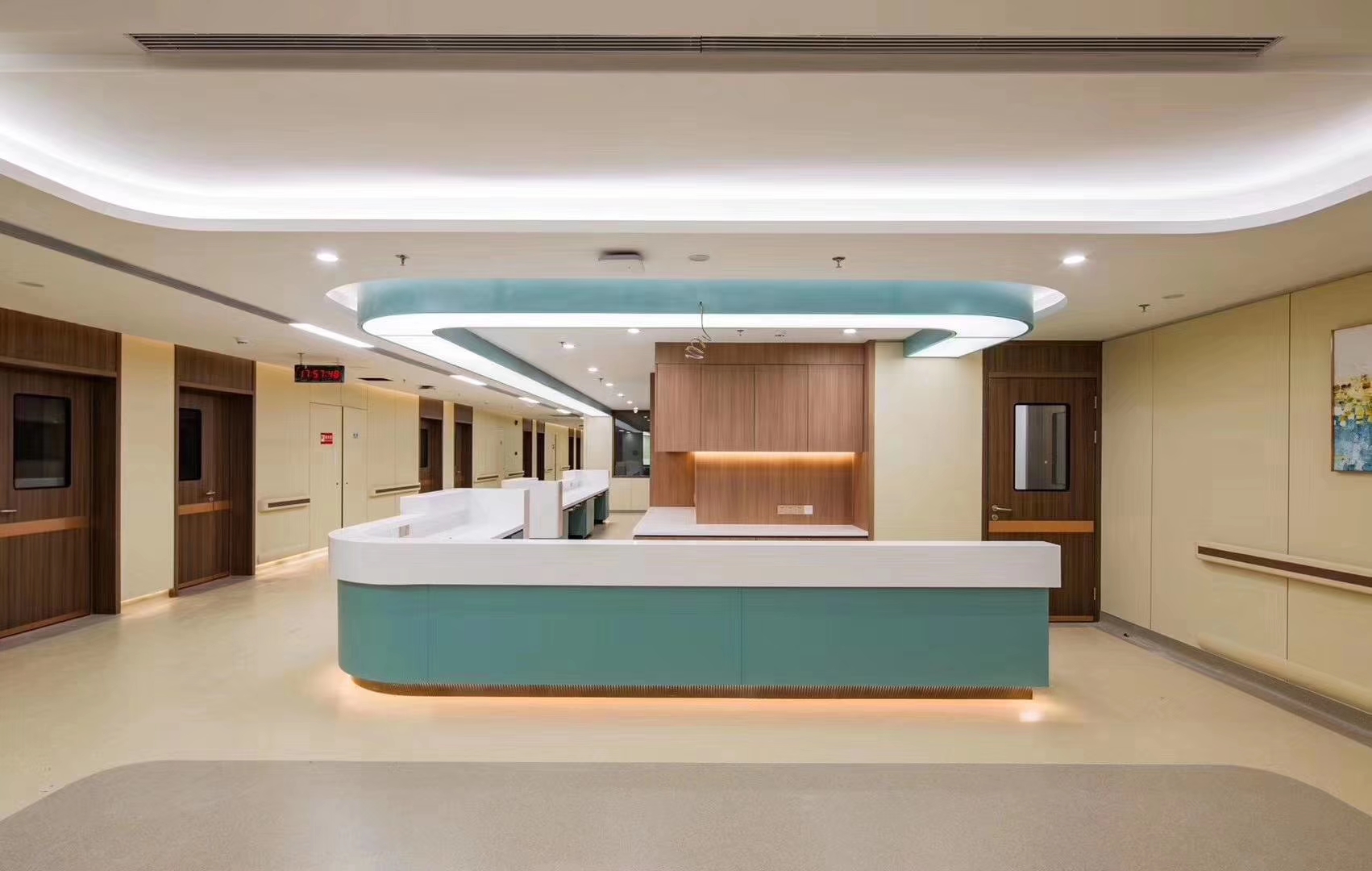
Large-area clean wall cladding: Hospital general wards, pharmaceutical clean rooms, food processing plant workshops—its flat surface, antibacterial performance, and modular installation make it easy to maintain a sterile environment.
Energy-saving and soundproofing-focused spaces: Office building interior partitions, hotel guest room walls—its inherent thermal and sound insulation properties reduce the need for additional insulation materials, lowering construction costs.
IV. Additional Key Considerations for Wall Applications
1. Installation Cost & Complexity
Phenolic compact laminate: Heavier weight requires reinforced fixing brackets, especially for thick boards, leading to slightly higher installation labor costs. However, its flexibility reduces material waste during customization.
Ice-fire board: Lightweight and modular, suitable for quick dry hanging installation. Large-area paving is efficient, making it more cost-effective for large-scale projects.
2. Long-Term Maintenance
Phenolic compact laminate: Low maintenance needs. Minor scratches can be polished and repaired; local damage allows for easy partial replacement without affecting the entire wall.
Ice-fire board: The decorative layer is prone to peeling if exposed to moisture or impact. Once the base board cracks, it usually requires replacement of the entire panel, resulting in higher long-term maintenance costs.
3. Environmental Protection
Both materials meet national E1-level formaldehyde emission standards. High-quality phenolic compact laminate uses environmentally friendly phenolic resin with no volatile organic compounds (VOCs) after curing. Ice-fire boards, with their inorganic base, are inherently free of formaldehyde emissions.
V. Summary: Selection Guidelines
Selection Factor
Recommended Material
High impact resistance, moisture resistance, or customized shapes
Phenolic Compact Laminate
Class A fire rating, sterile environment, or large-area modular paving
Fireproof Decorative Board (Ice-Fire Board)
In conclusion, phenolic compact laminate excels in durability and versatility, while fireproof decorative boards stand out in fire safety and hygiene. For wall applications, the optimal choice depends on balancing fire requirements, environmental conditions, and design needs—ensuring the material not only meets functional standards but also delivers long-term cost-effectiveness.
 Русский
 English
 العربية
 Français
 Español
 Português
 Deutsch
 italiano
 日本語
日本語 한국어
한국어 Nederlands
 Tiếng Việt
 ไทย
ไทย Polski
 Türkçe
 አማርኛ
አማርኛ Bahasa Melayu
 தமிழ்
தமிழ் Filipino
 Bahasa Indonesia
 magyar
 Română
 Монгол
 қазақ
қазақ Српски
 हिन्दी
 فارسی
فارسی Kiswahili
 Slovenčina
 Slovenščina
 Svenska
 українська
 Ελληνικά
 Suomi
Suomi Հայերեն
 עברית
עברית اردو
اردو Shqip
Shqip বাংলা
বাংলা Hrvatski
 Afrikaans
 Māori
Māori සිංහල
සිංහල Oʻzbekcha
 latviešu
 Беларуская мова
 Bosanski
 Български
 ქართული
 Lietuvių
 Malti
Malti Runasimi