This website uses cookies and similar technologies (“cookies”). Subject to your consent, will use analytical cookies to track which content interests you, and marketing cookies to display interest-based advertising. We use third-party providers for these measures, who may also use the data for their own purposes.
You give your consent by clicking "Accept all" or by applying your individual settings. Your data may then also be processed in third countries outside the EU, such as the US, which do not have a corresponding level of data protection and where, in particular, access by local authorities may not be effectively prevented. You can revoke your consent with immediate effect at any time. If you click on "Reject all", only strictly necessary cookies will be used.
A high pressure laminate and compact panel manufacturer established in 1998.
You are here:Home » Blog » HPL vs Plywood: Which Material Is Better?
HPL vs Plywood: Which Material Is Better?
Views: 0 Author: Serena Sun Publish Time: 2026-08-27 Origin: Site
HPL vs Plywood: Which Is Better for Furniture and Cabinets?
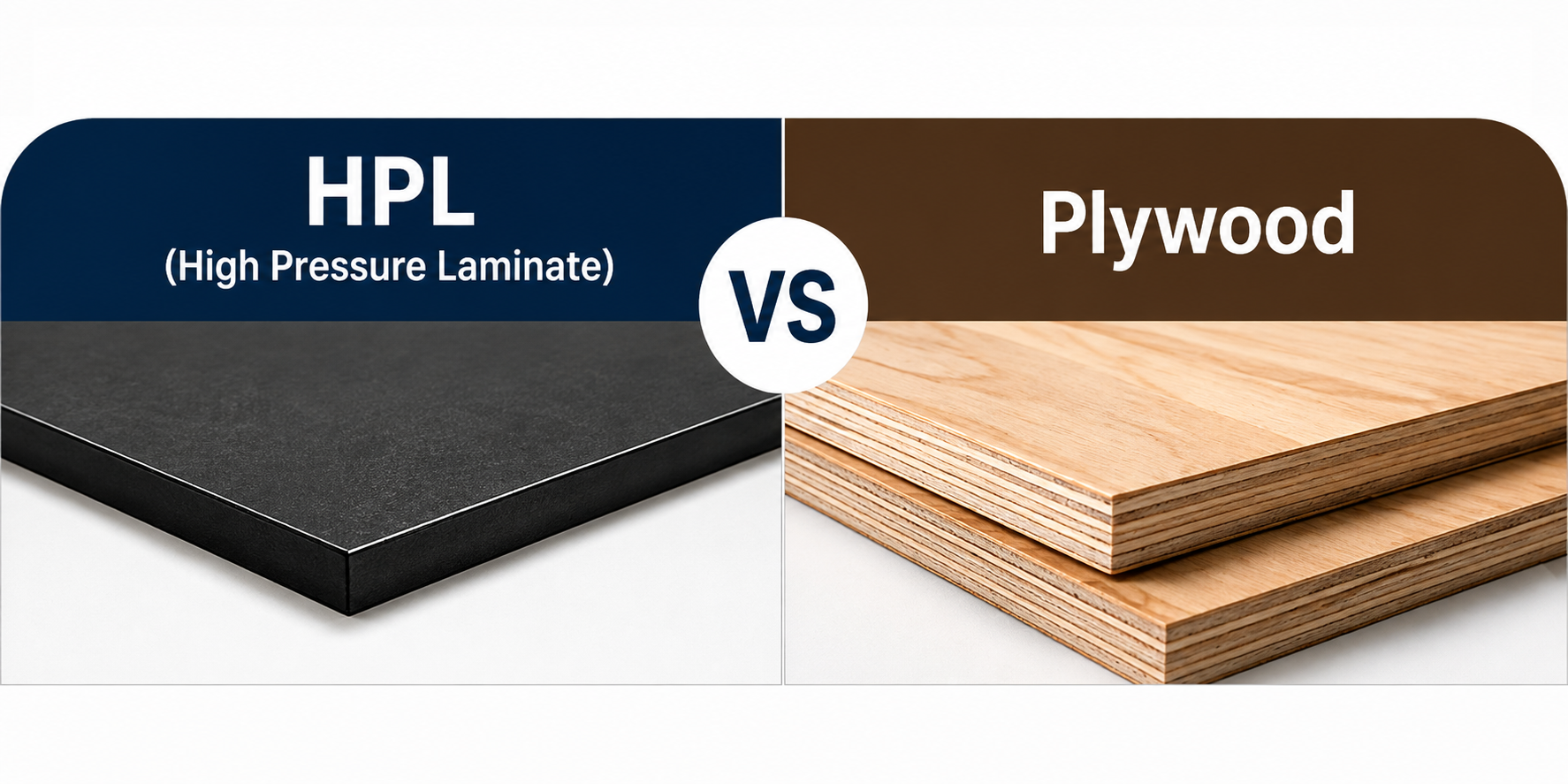
HPL and plywood are often compared as if they perform the same job, but in most furniture and interior projects they serve different functions. Plywood is primarily a structural engineered wood panel, while HPL is a durable decorative surface material.
For cabinets, desks, counters, hotel furniture and commercial interiors, the practical solution is often not choosing one material instead of the other. A suitable plywood substrate can provide structural strength, while High Pressure Laminate provides a durable, easy-to-clean and design-consistent surface.
This guide compares HPL and plywood by structure, surface performance, moisture behavior, cost, fabrication and end-use application to help furniture manufacturers, contractors, distributors and project buyers select the right panel construction.
Quick Answer: HPL and Plywood Serve Different Roles
Choose plywood when structural strength, screw holding, machining and panel rigidity are the primary requirements.
Choose HPL when the visible surface needs better scratch resistance, stain resistance, design consistency and easier maintenance.
For many cabinets and commercial furniture projects, HPL laminated onto an appropriate substrate provides a practical combination of structure and surface performance.
The correct choice therefore depends on the complete panel specification rather than simply asking whether HPL or plywood is better.
What Is Plywood?
Plywood is an engineered wood panel manufactured from multiple wood veneers bonded with the grain direction alternating between layers. This cross-laminated structure provides useful strength, dimensional stability and machining performance.
Plywood is commonly used for cabinet carcasses, furniture frames, shelving, interior panels and other applications that require structural support and mechanical fastening.
Its final surface performance depends on the plywood grade and finishing system. Unfinished plywood normally requires paint, veneer, laminate or another surface treatment when appearance, stain resistance and easy maintenance are important.
What Is HPL?
HPL, or High Pressure Laminate, is produced by consolidating resin-impregnated kraft paper and decorative surface layers under heat and pressure. The resulting laminate provides a durable decorative surface for furniture and interior applications.
Thin decorative HPL is normally bonded to a suitable substrate such as engineered wood panels. Depending on product grade, substrate selection and fabrication requirements, plywood can also be used as part of a laminated composite panel.
Compact HPL is different from thin decorative laminate. Its thicker solid phenolic core allows suitable grades to be used as self-supporting panels for applications such as toilet partitions, lockers, furniture and interior panels.
HPL vs Plywood Comparison
Comparison Factor
HPL
Plywood
Primary Function
Decorative and protective surface
Structural engineered wood panel
Structural Strength
Thin HPL is not intended as a structural panel
Good structural performance depending on grade and thickness
Scratch and Wear Resistance
High for suitable HPL grades
Depends on veneer and surface finish
Stain Resistance
Good surface resistance and easy cleaning
Depends on coating or finishing system
Moisture Performance
HPL surface is moisture resistant; full panel performance depends on substrate, bonding and edge sealing
Depends strongly on plywood grade, adhesive and edge protection
Design Options
Solid colors, woodgrains, stone, matte, metallic and decorative patterns
Natural wood appearance or finished surface
Color Consistency
High consistency within controlled production batches
Natural veneer appearance can vary
Screw Holding
Depends on the supporting substrate or compact panel grade
Generally suitable for mechanical fastening depending on grade and thickness
Maintenance
Low-maintenance, wipe-clean decorative surface
Depends on surface coating and use environment
Typical Applications
Furniture surfaces, cabinets, counters, wall panels and commercial interiors
Cabinet structures, furniture panels, shelving and structural interior components
HPL vs Plywood for Cabinets
For cabinet construction, plywood can provide the structural body, shelves and other load-bearing components. HPL can then be applied to suitable surfaces when improved durability, cleanability and decorative consistency are required.
This combination is often considered for kitchens, hotels, offices, schools, retail interiors and other locations where cabinets experience frequent contact and regular cleaning.
However, buyers should specify the complete assembly, including plywood grade, laminate grade, adhesive, backer or balancing layer where required, finished thickness and edge treatment.
HPL vs Plywood for Furniture
For residential furniture where natural wood appearance is the main priority, finished plywood may be sufficient.
For commercial furniture used in offices, schools, hotels, restaurants and retail spaces, an HPL-faced panel can provide a harder decorative surface and reduce routine maintenance compared with unfinished wood-based surfaces.
Typical applications include desks, counters, storage units, tables, wardrobes, reception furniture and display fixtures.
HPL vs Plywood for Kitchen Applications
Kitchen panels are exposed to grease, spills, humidity and frequent cleaning. A suitable plywood grade can provide structural support, while HPL can provide a durable decorative surface for cabinet doors, work surfaces and related furniture components.
For countertop applications, material selection should consider substrate stability, adhesive, edge construction, cut-outs and the expected level of moisture and heat exposure.
You can also review POLYBETT HPL Kitchen Countertop solutions for applications where surface durability and decorative consistency are important.
Is HPL Waterproof?
HPL provides good resistance to normal surface moisture, but a laminated plywood panel should not automatically be described as completely waterproof.
Moisture can enter through unsealed edges, joints, drill holes, damaged surfaces and cut-outs. The performance of the finished panel depends on the HPL grade, substrate, adhesive system, edge sealing, fabrication and installation.
For humid environments, buyers should specify the appropriate substrate grade and edge treatment instead of relying only on the laminate surface.
Fire Performance of HPL and Plywood
There is no single fire rating that applies to every HPL or plywood product. Fire performance depends on the specific laminate grade, substrate and complete panel construction.
For hotels, hospitals, schools, transportation projects and other regulated buildings, buyers should request the applicable fire test report and confirm that the tested construction matches the material being supplied.
Can HPL Be Laminated to Plywood?
Yes. HPL can be bonded to appropriate plywood for furniture and interior applications, but successful fabrication depends on more than simply applying adhesive between two sheets.
The plywood should have a sufficiently flat and suitable bonding surface. Moisture content, veneer quality, adhesive selection, pressing conditions and laminate conditioning can affect the finished panel.
For larger panels, manufacturers should also consider panel balance. Using an appropriate backing construction can help control distortion caused by different dimensional movement between laminate and substrate.
HPL vs Plywood Cost
Directly comparing the price of one square meter of HPL with one square meter of plywood is usually not useful because the materials perform different functions.
A finished plywood panel may require sanding, painting, coating or veneering. An HPL-faced panel adds laminate, adhesive, pressing and edge-processing costs but can reduce later finishing and maintenance requirements.
For B2B projects, compare the total finished-panel cost, including substrate, surface material, fabrication, edge treatment, installation, maintenance and expected service life.
When Should You Choose Plywood?
Plywood is generally the better starting point when the project requires structural panel strength, screw holding, machining, furniture framing or a natural wood appearance.
It is commonly selected for cabinet carcasses, shelving, furniture structures and other applications where the substrate itself must carry loads or accept mechanical fasteners.
When Should You Choose HPL?
HPL is appropriate when the visible surface needs improved wear resistance, scratch resistance, stain resistance, consistent decoration and easy maintenance.
It is particularly useful for furniture and surfaces in commercial environments such as schools, hotels, offices, restaurants, retail stores and healthcare interiors where repeated contact and cleaning are expected.
When Should You Combine HPL and Plywood?
Combining the two materials can make sense when the project needs both structural support and a durable decorative finish.
Plywood provides the supporting panel, while HPL protects and decorates the visible surface. The complete construction should be engineered according to the application rather than treating HPL as a structural replacement for plywood.
Verify performance documents: Request relevant technical data, certifications and test reports when the project has formal compliance requirements.
Confirm color and finish: Check decorative code, texture, gloss level and batch consistency before bulk production.
Request samples: Evaluate physical samples or pre-production panels before confirming high-volume orders.
Common HPL and Plywood Procurement Mistakes
Comparing raw sheet prices only: The finished panel cost can include adhesive, pressing, machining, edge treatment and installation.
Assuming all HPL grades are identical: Different laminate grades can have different thickness, forming capability, surface performance and intended applications.
Ignoring substrate quality: A high-quality decorative surface cannot compensate for an unsuitable or unstable substrate.
Calling the complete panel waterproof: Moisture performance depends on the entire assembly, especially joints, edges and cut-outs.
Ignoring batch consistency: Large commercial projects should confirm color and finish consistency before production.
POLYBETT HPL Solutions for Furniture and Interiors
POLYBETT supplies HPL solutions for furniture, cabinetry, countertops, wall panels, toilet partitions and commercial interior projects. Available options include decorative HPL, compact laminate, solid color core laminate, anti-fingerprint surfaces and specialized functional laminate products.
For furniture manufacturers, contractors, distributors and project buyers, specifications can be discussed according to required dimensions, thickness, surface finish, color, quantity and end-use application.
They are not directly comparable in this way. Plywood is a structural panel, while thin HPL is primarily a decorative and protective surface. The appropriate material depends on whether the project requires structural strength or surface performance.
Can HPL be applied to plywood?
Yes. HPL can be bonded to suitable plywood, provided the substrate, adhesive, conditioning and pressing process are appropriate. Panel balance and dimensional stability should also be considered for larger components.
Which is better for kitchen cabinets, HPL or plywood?
They normally perform different roles. Plywood can be used for structural cabinet components, while HPL can provide a durable decorative surface. The final specification should consider moisture exposure, substrate grade, edge sealing and fabrication.
Can HPL be used without plywood?
Thin decorative HPL normally requires a suitable substrate. Compact HPL is a thicker solid-core laminate that can be used as a self-supporting panel in suitable applications.
Is HPL-faced plywood waterproof?
It should not automatically be considered waterproof. Although the HPL surface provides moisture resistance, water can enter through edges, joints, drill holes and cut-outs if the complete panel is not properly designed and sealed.
Is HPL-faced plywood suitable for commercial furniture?
It can be suitable for desks, cabinets, storage units, counters and other commercial furniture when the substrate, laminate, adhesive and fabrication method are correctly specified for the intended use.
What should buyers specify when ordering HPL panels?
Provide the laminate type, color, finish, thickness, substrate type, finished panel dimensions, quantity, application and any required fire, environmental or performance standards. Drawings can also help confirm fabrication requirements.
Conclusion: HPL or Plywood?
There is no universal winner between HPL and plywood because they perform different functions. Plywood is useful when structural strength, fastening and machining are required. HPL is useful when the visible surface requires durability, decorative consistency and easier maintenance.
For many cabinets, furniture and commercial interior applications, the best specification is a properly engineered composite panel that combines an appropriate substrate with the required HPL surface.
B2B buyers should therefore evaluate the complete panel construction, application environment, test requirements and fabrication method rather than choosing materials based only on raw sheet price.
The general manager of Changzhou Zhongtian Fire-resistant Decorative Board Co., Ltd., has been deeply involved in the HPL fireproof board industry for 15 years.
 Русский
 English
 العربية
 Français
 Español
 Português
 Deutsch
 italiano
 日本語
日本語 한국어
한국어 Nederlands
 Tiếng Việt
 ไทย
ไทย Polski
 Türkçe
 አማርኛ
አማርኛ Bahasa Melayu
 தமிழ்
தமிழ் Filipino
 Bahasa Indonesia
 magyar
 Română
 Монгол
 қазақ
қазақ Српски
 हिन्दी
 فارسی
فارسی Kiswahili
 Slovenčina
 Slovenščina
 Svenska
 українська
 Ελληνικά
 Suomi
Suomi Հայերեն
 עברית
עברית اردو
اردو Shqip
Shqip বাংলা
বাংলা Hrvatski
 Afrikaans
 Māori
Māori සිංහල
සිංහල Oʻzbekcha
 latviešu
 Беларуская мова
 Bosanski
 Български
 ქართული
 Lietuvių
 Malti
Malti Runasimi