This website uses cookies and similar technologies (“cookies”). Subject to your consent, will use analytical cookies to track which content interests you, and marketing cookies to display interest-based advertising. We use third-party providers for these measures, who may also use the data for their own purposes.
You give your consent by clicking "Accept all" or by applying your individual settings. Your data may then also be processed in third countries outside the EU, such as the US, which do not have a corresponding level of data protection and where, in particular, access by local authorities may not be effectively prevented. You can revoke your consent with immediate effect at any time. If you click on "Reject all", only strictly necessary cookies will be used.
As a leading manufacturer over 20 years. Our exquisite craftsmanship can meet all your requirements!
Views: 0 Author: Serena Sun Publish Time: 2026-08-18 Origin: Site
High-Pressure Laminate (HPL) has become the most reliable surface material for modern renovation projects, including public restroom partitions, kitchen and wardrobe cabinetry, and interior wall cladding. Compared with MDF, particleboard, and ordinary decorative panels, genuine compact laminate delivers superior moisture resistance, wear resistance, and structural stability.
However, many buyers face confusion due to uneven market quality, mixed-generation products, inconsistent thickness standards, and unclear budget matching rules. Many low-cost alternatives look identical on the surface but fail rapidly in humid or high-traffic environments.
This 2026 professional guide explains compact laminate core structure, performance benchmarks, budget matching logic, updated installation acceptance standards, maintenance rules, and hidden purchasing risks to help architects, contractors, and homeowners select qualified HPL materials and avoid common project failures.
Table of Contents
Toggle
1. What Is Genuine Compact Laminate? Core Structure & Performance Standards
Genuine phenolic laminate (first-generation HPL) is a thermosetting panel formed under high temperature and high pressure in one integrated pressing process. It consists of two core layers:
Core layer: Multiple layers of kraft paper fully impregnated with phenolic resin
Decorative surface layer: Melamine-resin-treated printed paper with wear-resistant protection
The overall performance of compact laminate depends entirely on the combination of phenolic core density and melamine surface quality.
1.1 Standard Density Range
Qualified first-generation compact laminate maintains a stable density of 1350–1450 kg/m³. This high density ensures excellent load-bearing performance, anti-deformation capability, and stable screw-holding strength for cabinet installation and public partition use.
1.2 Surface Wear Resistance Standard
Industry-qualified compact laminate must withstand a minimum of 6,000 abrasion cycles. The melamine surface provides acid resistance, alkali resistance, and moderate UV stability, ensuring long-term durability in high-frequency public spaces.
1.3 Core Advantage Over Ordinary Boards
Unlike MDF and particleboard, genuine phenolic-core compact laminate is fully waterproof, anti-swelling, and anti-delaminating, making it the only reliable panel for long-term humid environment applications.
2. First-Generation vs Second-Generation Compact Laminate: Critical Difference
Most market quality problems come from confusing first-generation and second-generation boards.
Only the HPL surface is water-resistant; the core absorbs moisture easily
Prone to bulging, warping, and layer separation after 3–6 months in humid conditions
Only suitable for: dry indoor decorative walls, low-traffic furniture
Key Reminder: Only first-generation phenolic core boards can be used for toilet partitions and wet-area projects.
3. How to Match HPL Specifications & Budget for Different Applications
Budget differences do not change the authenticity of compact laminate. They only adjust thickness, surface craftsmanship, and functional upgrades. You can optimize costs based on usage scenarios.
3.1 Public Restroom Partitions (Strict Standard)
Minimum thickness: 12mm
Mandatory standard: E1/E0/ENF environmental grade + full phenolic core
Priority: core density, waterproof performance, impact resistance, and hardware compatibility
3.2 Kitchen Cabinets & Wardrobes
Standard thickness can be reduced appropriately
Focus on screw-holding strength and anti-deformation performance
High-end projects can upgrade to antibacterial, anti-fingerprint, or custom color finishes
3.3 Interior Wall Cladding
Low mechanical impact demand
Budget can focus more on surface texture, color consistency, and decorative effects
No need for over-specified ultra-high density core
3.4 Core Budget Logic
High-wear, wet areas: Prioritize core density and wear-resistant layers Low-traffic decorative areas: Prioritize surface aesthetics and save core material cost
4. 2026 New Installation & Acceptance Standards
The service life of compact laminate depends not only on board quality but also on standardized installation and strict acceptance checks.
4.1 Pre-Installation Inspection
Unified batch usage: The same visible wall or space must use panels from one production batch to avoid color difference
Check latest environmental and fire resistance test reports
❌ Low price equals cost-effective (Wrong: ultra-low price boards reduce kraft paper layers or use recycled materials)
5.2 Typical Cutting-Corner Tricks
Marking 11.8mm thin boards as standard 12mm
Mixing urea-formaldehyde core boards in partition projects
Using old stock panels with unstable color difference
5.3 Quick Genuine Board Inspection Method
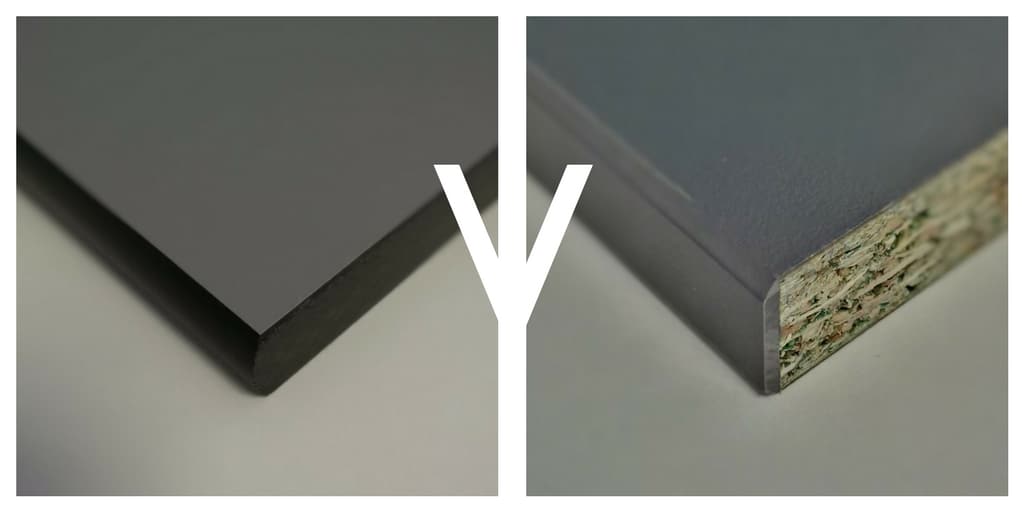
Cross-section check: Uniform dark brown core without white layered streaks
Odor check: No pungent acidic chemical smell
Document check: Valid third-party test reports within 3 months
6. Final Pre-Order Checklist (Must Follow)
Confirm application scenario: wet area partition ≥12mm phenolic core
Verify manufacturer qualification and latest quality reports
Confirm batch color consistency to avoid on-site disputes
Check supporting hardware quality to prevent hardware-driven failure
Reserve 5% material waste to avoid color difference from supplementary orders
Avoid bulk ordering only by small samples; request full-size panel effect confirmation
7. Frequently Asked Questions (FAQ)
Q1: Can HPL wall panels be directly pasted on raw walls?
No. Compact HPL is rigid and non-flexible. Direct adhesion causes hollowing, peeling, and uneven flatness. Standard installation requires a levelled substrate (OSB or keel frame) plus dual fixing of structural adhesive and mechanical fasteners.
Q2: What is the best thickness for restroom partition HPL?
Public toilets: 12mm–18mm (best balance of strength and cost)
Residential wet-dry separation: 8mm–10mm
Below 12mm: easy loosening from door vibration
Above 18mm: redundant performance and heavy hardware load
Q3: How to 100% verify genuine compact laminate?
Check uniform dark brown phenolic cross-section, no irritating odor, complete fire and environmental certificates, and clear surface wear layer texture. Avoid products with fuzzy surfaces, rough edges, and missing test reports.
Conclusion
Choosing the right compact laminate HPL is not about choosing the most expensive material, but about matching core performance, thickness specification, and surface function to your actual renovation scenario. First-generation phenolic core compact laminate remains the most cost-effective, durable, and safe solution for wet-area partitions, high-traffic public spaces, and long-term commercial decoration.
By following the 2026 inspection standards, budget matching rules, and anti-risk checklist in this guide, buyers can effectively avoid fake boards, cutting-corner materials, and post-installation quality failures.
 Русский
 English
 العربية
 Français
 Español
 Português
 Deutsch
 italiano
 日本語
日本語 한국어
한국어 Nederlands
 Tiếng Việt
 ไทย
ไทย Polski
 Türkçe
 አማርኛ
አማርኛ Bahasa Melayu
 தமிழ்
தமிழ் Filipino
 Bahasa Indonesia
 magyar
 Română
 Монгол
 қазақ
қазақ Српски
 हिन्दी
 فارسی
فارسی Kiswahili
 Slovenčina
 Slovenščina
 Svenska
 українська
 Ελληνικά
 Suomi
Suomi Հայերեն
 עברית
עברית اردو
اردو Shqip
Shqip বাংলা
বাংলা Hrvatski
 Afrikaans
 Māori
Māori සිංහල
සිංහල Oʻzbekcha
 latviešu
 Беларуская мова
 Bosanski
 Български
 ქართული
 Lietuvių
 Malti
Malti Runasimi