This website uses cookies and similar technologies (“cookies”). Subject to your consent, will use analytical cookies to track which content interests you, and marketing cookies to display interest-based advertising. We use third-party providers for these measures, who may also use the data for their own purposes.
You give your consent by clicking "Accept all" or by applying your individual settings. Your data may then also be processed in third countries outside the EU, such as the US, which do not have a corresponding level of data protection and where, in particular, access by local authorities may not be effectively prevented. You can revoke your consent with immediate effect at any time. If you click on "Reject all", only strictly necessary cookies will be used.
As a leading manufacturer over 20 years. Our exquisite craftsmanship can meet all your requirements!
You are here:Home » Blog » Why Cheap HPL Panels Crack & The Ultimate Guide to Identify Genuine HPL
Why Cheap HPL Panels Crack & The Ultimate Guide to Identify Genuine HPL
Views: 0 Author: Serena Sun Publish Time: 2026-09-15 Origin: Site
High Pressure Laminate (HPL) is a mainstream decorative material widely adopted in hotel wall cladding, commercial furniture, office decoration, and public toilet partitions. It is favored by designers and contractors for its excellent durability, stable fire resistance, diverse decorative effects, and low maintenance costs. Nevertheless, the market is flooded with low-cost counterfeit HPL panels that frequently develop cracks, delamination, fading, and warping after short-term installation. These inferior products lead to costly rework, project delays, and hidden safety hazards for commercial construction projects.
Most HPL cracking issues are not caused by improper installation alone. They stem from shoddy raw materials, substandard manufacturing techniques, and unstable resin formulas. This article systematically explains why budget HPL panels crack easily and delivers a comprehensive, field-tested guide to help buyers accurately distinguish genuine high-performance HPL from low-grade imitations.
Table of Contents
Toggle
1. Root Causes of Cracking on Low-Grade HPL Panels
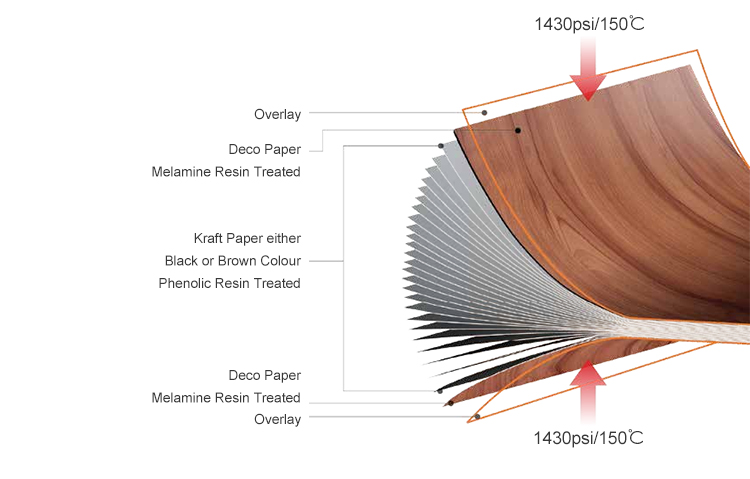
Authentic HPL is manufactured through strict high-temperature and high-pressure thermosetting curing, forming a dense, integrated multi-layer structure with superior dimensional stability and structural toughness. In contrast, cheap HPL cuts corners in raw material selection and production processes, resulting in loose internal structures that are highly susceptible to cracking under temperature fluctuations, moisture erosion, and daily mechanical stress.
1.1 Inferior Raw Materials and Insufficient Resin Impregnation
Genuine HPL uses high-density thick kraft paper fully and uniformly impregnated with high-stability phenolic resin. All layered structures are tightly bonded without internal gaps. To reduce production costs, low-end manufacturers adopt recycled thin kraft paper and drastically reduce phenolic resin usage. Some even replace premium phenolic resin with low-cost urea-formaldehyde resin.
Insufficient resin saturation and poor material quality leave numerous invisible voids between panel layers. When exposed to thermal expansion and contraction, unbalanced internal stress destroys weak bonding structures, directly causing surface cracks, edge splitting, and interlayer delamination.
1.2 Substandard High-Pressure Curing Process
Complete HPL molding relies on three core standards: high pressure, constant high temperature, and sufficient curing time. Cheap HPL producers shorten pressing cycles and lower pressure and temperature parameters to boost output and cut energy costs. This incomplete thermosetting reaction results in loose, low-density internal structures.
Such unqualified panels lack structural stability and cannot resist daily impact, friction, or environmental changes, making random surface cracking a common and unavoidable defect.
1.3 Missing Professional Edge Sealing and Post-Processing
The cut edges of HPL are the weakest structural part of the panel. Formal standardized production includes precision cutting and professional edge sealing to block external moisture and dust penetration. Most low-cost HPL products omit edge treatment, leaving exposed loose fiber layers.
Moisture invades the panel interior through unprotected edges, causing local swelling and deformation. The resulting unbalanced internal stress gradually spreads outward, forming visible cracks on the panel surface over time.
1.4 Improper Substrate Matching and Non-Standard Installation
Counterfeit thin HPL panels have extremely poor dimensional stability. When attached to uneven, unpolished substrates or installed without reserved thermal expansion gaps, the panel cannot release accumulated thermal and moisture stress. Long-term stress accumulation eventually triggers cracks on flat surfaces and corners — a problem rarely occurring on genuine high-density HPL panels.
2. 11 Professional Field Methods to Identify Genuine HPL
Without professional laboratory testing equipment, purchasers and construction personnel can accurately verify HPL authenticity through visual inspection, physical tests, chemical resistance detection, and simple auxiliary experiments. The following 11 practical identification methods cover all quality judgment dimensions to effectively screen out inferior counterfeit HPL.
The cross-section structure directly reflects HPL quality. Genuine HPL features neatly arranged, tightly stacked kraft paper layers with uniform resin filling, no voids, gaps, or loose fibers. Low-grade fake HPL has fuzzy, disordered cross-sections with obvious hollow layers; internal fibers peel off easily by hand, indicating incomplete interlayer bonding and unstable structure.
2.2 Surface Hardness and Scratch Resistance Test
High-pressure thermosetting endows genuine HPL with a super-hard dense surface. Light scratching with a metal key leaves no permanent marks or cracks. Cheap HPL has a soft surface with poor abrasion resistance. Minor scratches will gradually expand into obvious cracks under long-term friction and environmental changes.
2.3 Authoritative Certification and Document Verification
Reliable HPL manufacturers provide complete third-party test reports covering panel density, abrasion resistance, dimensional stability, fire rating, and formaldehyde emission. Inferior HPL suppliers cannot offer standardized official certifications and only provide informal promotional materials, which is a typical sign of unqualified products.
2.4 Thermal and Humidity Stability Test
Place HPL samples in alternating hot and humid environments. Genuine HPL maintains perfect flatness and structural stability with no deformation or damage. Fake HPL with loose internal structures quickly warps, blisters, and develops fine cracks due to poor temperature and moisture resistance.
2.5 Weight and Density Comparison
Under the same thickness and size specifications, genuine HPL is noticeably heavier, thanks to high resin content and dense layered structure. If a sample is significantly lighter than industry-standard HPL, it confirms insufficient raw material filling and low molding density, with a high risk of post-installation cracking.
2.6 Combustion and Smoke Test (Waste Offcut Only)
This test is only valid for discarded panel offcuts. Genuine phenolic-based HPL burns slowly and self-extinguishes immediately after leaving the fire source. It produces faint, odorless light smoke and forms hard, brittle carbon residue without melting or dripping.
In contrast, cheap urea-resin HPL burns violently, releases thick black smoke with a strong pungent odor, and melts and drips at high temperatures, proving poor heat resistance and unstable structural performance.
2.7 Alcohol Wipe Color Durability Test
Wipe the decorative surface repeatedly with alcohol or daily disinfectant for 30 to 60 seconds. Genuine HPL’s decorative layer is integrally fused under the high-density protective overlay, with no fading, blurring, or peeling.
Counterfeit HPL adopts simple surface coating printing without integrated protection. Its surface color wears off and fades easily after frequent wiping, exposing the base material and accelerating aging and cracking.
2.8 Edge Layer Peeling Test
Gently pry the sample edge with a flat screwdriver. Genuine HPL layers are tightly fused as a whole and cannot be separated or peeled off. Inferior HPL has extremely weak interlayer bonding; paper layers split and peel off effortlessly. This latent delamination defect will gradually evolve into large-area cracks after installation.
2.9 Odor Identification Test
Smell the fresh cross-section of the panel. Qualified phenolic HPL only emits a faint, natural resin odor with no irritation. Low-cost fake HPL uses inferior urea-formaldehyde resin, releasing a strong pungent ammonia smell, which indicates unstable quality and excessive harmful gas emissions.
2.10 24-Hour Water Soaking Test
Submerge HPL samples in room-temperature water for 24 consecutive hours. Genuine HPL’s compact non-porous structure results in negligible water absorption, with no edge swelling, interlayer blistering, or panel warping.
Counterfeit HPL absorbs water severely, causing obvious edge expansion, internal blistering, and overall warpage. Long-term moisture erosion will continuously aggravate structural damage and trigger widespread cracking.
2.11 Surface Overlay Gloss and Texture Inspection
Observe the panel surface under strong oblique light. Authentic HPL has a uniform, transparent, high-density protective overlay with consistent gloss, delicate texture, and no surface flaws.
Cheap HPL omits premium overlay treatment, resulting in tiny pinholes, uneven gloss, blurred patterns, and thin fragile surface coatings that age rapidly and crack easily in daily use.
3. Key Procurement & Installation Tips to Avoid HPL Cracking
To completely avoid HPL cracking and quality risks in commercial projects, specifiers, contractors, and purchasers must adopt standardized procurement and construction specifications:
Clarify core technical parameters (density, abrasion grade, fire resistance standard, formaldehyde emission) in procurement contracts to prevent low-standard material substitution.
Confirm physical samples and complete full quality identification tests before bulk order production and delivery.
Adopt flat, qualified substrates and reserve reasonable thermal expansion gaps during installation to release structural stress.
Cooperate with formal, certified HPL manufacturers instead of blindly choosing ultra-low-cost products.
4. FAQ for HPL Quality Identification & Cracking Problems
4.1 Can cracked HPL panels be repaired?
Minor surface scratches can be polished and repaired, but deep cracks and interlayer delamination are irreversible. Once the internal layered structure is damaged, cracks will continue to spread. Panel replacement is the only reliable solution for structural failure.
4.2 Is thicker HPL always genuine and crack-proof?
Thickness alone cannot determine HPL quality. Unscrupulous manufacturers stack low-quality kraft paper to increase panel thickness. Always judge quality based on cross-section compactness, resin saturation, and surface hardness, rather than thickness.
4.3 What is the core difference between HPL and ordinary melamine boards?
Genuine HPL is an independent high-pressure thermoset laminate with multi-layer kraft paper structure, featuring high density and stable performance. Ordinary melamine boards simply press thin decorative paper directly onto MDF or particleboard without high-pressure integrated molding, resulting in poor stability and easy cracking — they are not real HPL.
4.4 Is the alcohol wipe test safe for HPL samples?
This test is only performed on spare panel offcuts. Authentic HPL has excellent chemical resistance to alcohol and daily disinfectants. Surface fading after wiping is a definitive sign of low-grade counterfeit HPL.
4.5 Why does resin type determine HPL crack resistance?
Phenolic resin for genuine HPL delivers high temperature resistance, stable bonding performance, and low shrinkage rate. Cheap urea-formaldehyde resin has poor thermal stability, shrinks severely with temperature changes, and easily causes interlayer separation and surface cracking.
5. Conclusion
Cracking failures of low-cost HPL panels are fundamentally caused by inferior raw materials and non-standard production processes. Genuine high-quality HPL achieves exceptional structural stability and crack resistance through high-purity resin impregnation, high-pressure integrated curing, and professional post-processing.
By mastering the complete set of visual, physical, chemical, and experimental identification methods, industry practitioners can effectively screen counterfeit HPL products, eliminate project quality risks, and ensure long-term stable and durable application of HPL panels in commercial interior decoration projects.
 Русский
 English
 العربية
 Français
 Español
 Português
 Deutsch
 italiano
 日本語
日本語 한국어
한국어 Nederlands
 Tiếng Việt
 ไทย
ไทย Polski
 Türkçe
 አማርኛ
አማርኛ Bahasa Melayu
 தமிழ்
தமிழ் Filipino
 Bahasa Indonesia
 magyar
 Română
 Монгол
 қазақ
қазақ Српски
 हिन्दी
 فارسی
فارسی Kiswahili
 Slovenčina
 Slovenščina
 Svenska
 українська
 Ελληνικά
 Suomi
Suomi Հայերեն
 עברית
עברית اردو
اردو Shqip
Shqip বাংলা
বাংলা Hrvatski
 Afrikaans
 Māori
Māori සිංහල
සිංහල Oʻzbekcha
 latviešu
 Беларуская мова
 Bosanski
 Български
 ქართული
 Lietuvių
 Malti
Malti Runasimi