This website uses cookies and similar technologies (“cookies”). Subject to your consent, will use analytical cookies to track which content interests you, and marketing cookies to display interest-based advertising. We use third-party providers for these measures, who may also use the data for their own purposes.
You give your consent by clicking "Accept all" or by applying your individual settings. Your data may then also be processed in third countries outside the EU, such as the US, which do not have a corresponding level of data protection and where, in particular, access by local authorities may not be effectively prevented. You can revoke your consent with immediate effect at any time. If you click on "Reject all", only strictly necessary cookies will be used.
As a leading manufacturer over 20 years. Our exquisite craftsmanship can meet all your requirements!
You are here:Home » Blog » HPL Table Top vs Solid Wood vs MDF Table Top – Complete Buyer Guide for Furniture Makers, Contractors & Designers
HPL Table Top vs Solid Wood vs MDF Table Top – Complete Buyer Guide for Furniture Makers, Contractors & Designers
Views: 0 Author: Serena Sun Publish Time: 2026-07-16 Origin: Site
Table of Contents
Toggle
1. Basic Structure Overview of Three Tabletop Materials
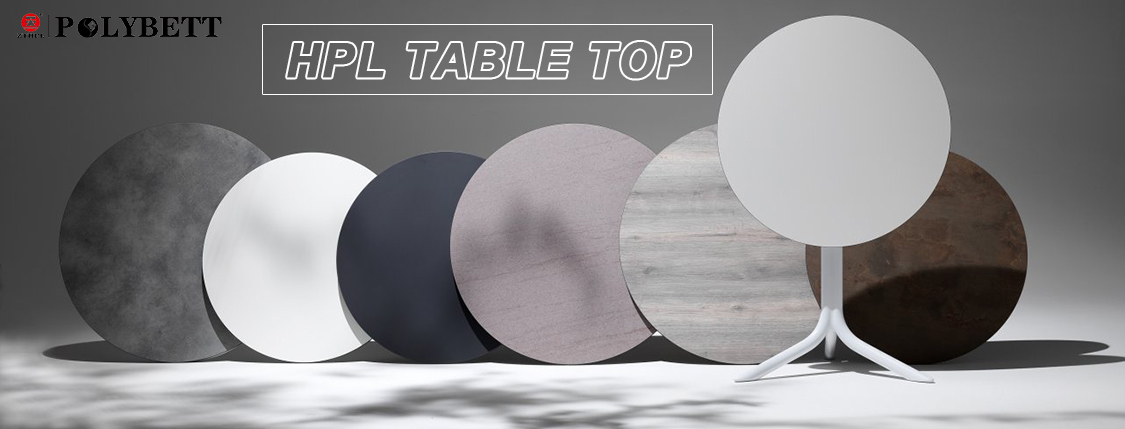
Phenolic HPL Table Top
Homogeneous solid hpl laminate formed by high-pressure hot pressing of phenolic resin-impregnated kraft paper and decorative surface layers. Available in standard brown kraft core and colour core (through-colour) grades, thickness 6–25mm. It is self-supporting and requires no additional substrate.
Note: Thin decorative HPL (0.6–1.2mm) must be bonded onto MDF or plywood; this article focuses on solid phenolic HPL for standalone tabletops.
Solid Wood Table Top
Solid hardwood or jointed solid timber (oak, walnut, ash, rubberwood etc.) with natural wood fibre structure. Surfaces are finished with wood oil, PU lacquer or water-based coating.
MDF Table Top
Medium Density Fibreboard made from compressed wood fibres and adhesive. Bare MDF cannot be used directly; nearly all commercial tabletops use MDF substrate covered with melamine veneer or thin decorative HPL, relying on edge banding to block moisture penetration.
2. Side-by-Side Performance Comparison Table
Evaluation Item
Phenolic HPL Table Top
Solid Wood Table Top
MDF (Veneer / HPL-Clad) Table Top
Water & Moisture Resistance
★★★★★ Zero water absorption; no swelling in damp environments
★★☆☆☆ Absorbs water easily; prone to mould, warping and deformation under prolonged humidity
★★☆☆☆ Swells permanently once edge banding fails; not suitable for splash zones
Scratch & Impact Resistance
★★★★★ Hard melamine surface; colour core avoids visible contrasting inner layer after abrasion
★★★☆☆ Easily scratched; heavy impact creates permanent dents
Not recommended for wet areas, restaurants with frequent liquid spills or public high-impact zones.
Once the surface veneer is broken, local repair is difficult; full panel replacement is usually needed.
Limited lifespan under heavy commercial use.
4. Edge Machining & Design Difference
HPL
Standard kraft core phenolic laminate shows brown inner kraft paper after cutting, requiring edge trim.
Colour core HPL: cross-section matches surface colour; chamfered, radiused and mitered edges can be left exposed without covering trim — perfect for monolithic minimalist furniture.
Solid Wood
All cut edges show natural wood grain. Designers can apply rounded, beveled, hand-scraped edge profiles; edges can be re-sanded and re-oiled during renovation.
MDF Tabletop
Raw cut edges are porous light brown fibre. Edge banding (PVC, acrylic or matching veneer) is mandatory for all visible edges. Once edge banding peels, water quickly infiltrates the core. No exposed-edge design allowed.
5. Best Application Matching for Different Projects
✅ Choose Phenolic HPL Table Top
School desks, student canteen dining tables
Hospital consultation counters, clinic worktables
Gym and poolside tables, changing room benches
Chain café & restaurant dining tables with frequent liquid spills
Public library, community centre high-traffic furniture
Projects requiring exposed-edge modern design (select colour core grade)
✅ Choose Solid Wood Table Top
High-end residential dining tables, villa study desks
Boutique coffee shops, designer restaurants focused on natural texture
Dry indoor boutique retail display furniture
Private office executive desks with low spill risk
✅ Choose MDF Clad Table Top
Standard office staff desks in dry air-conditioned offices
Low-budget residential renovation indoor tables
Short-term rental apartment furniture
Low-traffic administrative back-office furniture
Not recommended: catering, education, wet and public high-traffic zones.
HPL: Mid upfront investment, almost zero maintenance expense. No periodic refinishing or frequent replacement. Lowest total cost of ownership for commercial public projects.
Solid Wood: Highest initial cost plus recurring maintenance fees (polishing, repair, refinishing). Good ROI only for low-traffic high-end spaces.
MDF Tabletop: Lowest purchase price, but shorter service life. Multiple replacements needed within 15 years; hidden costs rise rapidly in commercial environments.
7. Key Specifications When Placing Orders
For HPL
Clarify: standard kraft core or colour core (if exposed edges are shown on drawings)
Thickness recommendation: 10–12mm for café tables; 12–16mm for school desks
Confirm surface finish: matte, anti-fingerprint, satin or custom texture
Request certificates: EN438, antibacterial or B1 fire rating if required for tender
For Solid Wood
Specify timber species, joint structure (solid jointed vs single slab)
Define surface coating type: water-based lacquer, PU coating or natural wood oil
Include anti-warping processing requirements in technical clauses
Specify full-surface HPL / melamine veneer; define edge band material and thickness
Clearly note: not suitable for wet or splash-prone areas
8. FAQ for Furniture Makers & Specifiers
Q1: Can HPL fully replace solid wood in commercial projects?
A: Functionally yes for durability and hygiene. If the design concept requires natural timber texture and organic tactile feeling, solid wood remains irreplaceable.
Q2: Is colour core HPL worth the extra cost for tabletops?
A: Yes when the design uses chamfered, rounded or miter exposed edges. Impact scratches will not reveal an unsightly contrasting brown core.
Q3: Can MDF tabletops be used in restaurants?
A: Not recommended. Spilled drinks, sauce and cleaning water will penetrate gaps around edge banding and cause permanent swelling within 1–3 years.
Q4: How to choose heat-resistant tabletop surfaces for catering?
A: Phenolic HPL is the most reliable option. Solid wood easily gets stained and blistered; MDF veneer risks surface bubbling from hot tableware.
Q5: Do solid wood tabletops continue to move and crack after installation?
A: All natural timber expands and contracts with humidity changes. Proper kiln drying reduces risks, but complete elimination is impossible.
 Русский
 English
 العربية
 Français
 Español
 Português
 Deutsch
 italiano
 日本語
日本語 한국어
한국어 Nederlands
 Tiếng Việt
 ไทย
ไทย Polski
 Türkçe
 አማርኛ
አማርኛ Bahasa Melayu
 தமிழ்
தமிழ் Filipino
 Bahasa Indonesia
 magyar
 Română
 Монгол
 қазақ
қазақ Српски
 हिन्दी
 فارسی
فارسی Kiswahili
 Slovenčina
 Slovenščina
 Svenska
 українська
 Ελληνικά
 Suomi
Suomi Հայերեն
 עברית
עברית اردو
اردو Shqip
Shqip বাংলা
বাংলা Hrvatski
 Afrikaans
 Māori
Māori සිංහල
සිංහල Oʻzbekcha
 latviešu
 Беларуская мова
 Bosanski
 Български
 ქართული
 Lietuvių
 Malti
Malti Runasimi