This website uses cookies and similar technologies (“cookies”). Subject to your consent, will use analytical cookies to track which content interests you, and marketing cookies to display interest-based advertising. We use third-party providers for these measures, who may also use the data for their own purposes.
You give your consent by clicking "Accept all" or by applying your individual settings. Your data may then also be processed in third countries outside the EU, such as the US, which do not have a corresponding level of data protection and where, in particular, access by local authorities may not be effectively prevented. You can revoke your consent with immediate effect at any time. If you click on "Reject all", only strictly necessary cookies will be used.
As a leading manufacturer over 20 years. Our exquisite craftsmanship can meet all your requirements!
You are here:Home » Blog » Product Knowledge Explanation » Why Two HPL Boards With Identical Surface Patterns Can Have 50% Price Difference and Wildly Different Lifespans
Why Two HPL Boards With Identical Surface Patterns Can Have 50% Price Difference and Wildly Different Lifespans
Views: 0 Author: Serena Sun Publish Time: 2026-09-29 Origin: Site
Introduction
It is a common puzzle for architects, contractors and fabricators: two HPL panels featuring exactly the same colour, texture and printed surface pattern, yet one costs half the price of the other. The visible decorative layer looks indistinguishable, but their real-world durability and service life diverge dramatically.
The secret lies not on the surface, but deep inside the core structure. Differences in resin formulation, kraft paper quality, resin saturation and hot-pressing parameters create hidden performance gaps. Cheap HPL with inferior core construction may delaminate, warp or crack within a few years, while premium pure phenolic core panels maintain integrity for decades. This guide unpacks HPL core construction, compares resin systems, contrasts pure phenolic and composite cores, and explains how core quality affects CNC machining results.
Table of Contents
Toggle
The Anatomy of the HPL Core
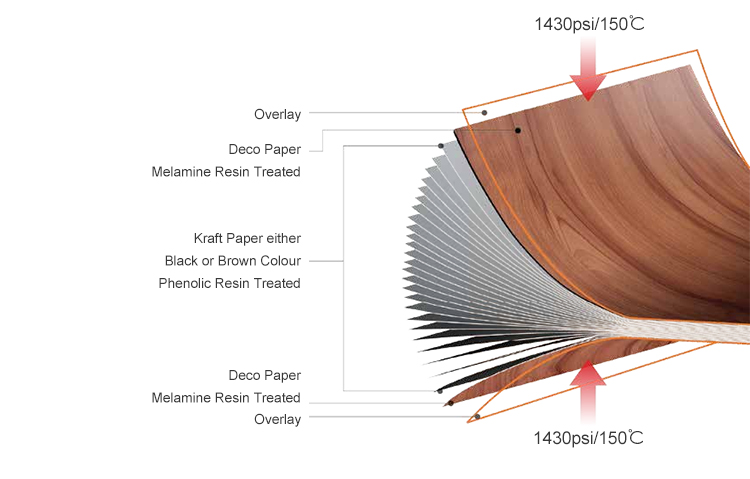
Multi-layered Build: Overlay, Decorative Paper, and Kraft Paper
Every finished HPL sheet consists of three distinct functional paper layers, each impregnated with targeted resin and fused together under high heat and pressure.
Overlay layer: A thin, transparent cellulose paper saturated with melamine resin. It sits on top of the decor layer, acting as a wear shield against abrasion, chemical stains and minor scratches.
Decorative paper: Printed paper carrying wood grain, solid colour or stone patterns. It is also soaked in melamine resin, locking in the printed design and creating the final visual finish.
Kraft paper core: Stacked thick brown kraft paper sheets, forming the bulk and structural backbone of HPL. This core layer determines mechanical strength, moisture stability and impact resistance. The resin used to saturate kraft paper is where most cost and quality differences arise.
Phenolic Resin vs Melamine Resin in Bonding
Melamine resin is reserved for the top overlay and decorative layers. It delivers excellent surface hardness, UV resistance and clear colour stability, making it ideal for the visible face. However, cured melamine resin has weaker water resistance compared to phenolic resin.
Phenolic resin is formulated for the kraft core. It is a thermosetting polymer with strong hydrophobic properties. Once fully cured under hot pressing, phenolic resin creates a rigid, water-repellent matrix that binds kraft fibres tightly together. The key rule: Melamine for surface beauty; phenolic for core structural and waterproof performance. Many low-cost manufacturers cut corners by substituting cheaper resins for the kraft core, sacrificing long-term stability to reduce material expenses.
Pure Phenolic Core vs Standard Composite Core
Pure Phenolic Core (全酚全木): 100% Boiling Water Resistance
Pure phenolic core, also known as full phenolic kraft laminate, means every kraft sheet in the entire core stack is fully impregnated with high-grade phenolic resin. After hot pressing, the panel forms a homogeneous void-free structure. It passes rigorous boiling testing: no delamination, bubbling or layer separation after 48 hours immersed in boiling water. This extreme water resistance makes pure phenolic core HPL suitable for wet high-traffic environments including public restrooms, pool changing rooms and humid locker areas.
Standard composite core HPL uses partial phenolic or blended low-cost resin in the kraft layers. While its decorative surface looks identical, the core has lower resin loading. When exposed to prolonged moisture, steam or temperature fluctuations, water wicks between paper layers, triggering delamination, swelling and mould growth. These panels are only fit for dry indoor applications and cannot withstand continuous wet exposure.
How to Spot Cheated Cores and Low-Resin Panels
Suppliers may market low-resin HPL with identical surface decor, hiding core defects from quick visual checks. Fabricators can identify inferior cheated cores with simple practical tests:
Edge brittleness check: A low-resin core appears loose and brittle at cut edges. Light tapping causes fine paper fibres to peel off. Premium pure phenolic core shows dense, tightly compressed layered cross-section; edges are firm and do not crumble easily.
Sanding behaviour: Sanding a cheated low-resin core produces fluffy loose paper dust. The layers separate easily under abrasion. Pure phenolic core generates fine dense powder, with no fibre separation during sanding.
Boiling test sample: For critical projects, submerse small cut samples in boiling water. Cheated cores will delaminate or bubble quickly, while full phenolic core remains intact.
How Core Density Impacts Machining: Avoid Edge-Chipping During CNC Routing
Core density directly decides how HPL performs during CNC cutting, routing and edge profiling — a major pain point for cabinet and cubicle fabricators. Pure phenolic core HPL has consistent, uniform density across the full thickness. When CNC tools cut through the panel, resin binds every kraft fibre firmly. Clean, smooth edges are achievable with proper tool speed, and edge chipping is minimised.
Low-density, cheated cores have inconsistent resin distribution and hidden micro voids inside. As the CNC cutter passes through, the weakly bonded kraft layers separate. The result is frequent edge chipping, rough frayed edges and visible layer splitting. These defects add extra labour for rework, sanding and finishing, raising total fabrication time and costs.
Even with identical surface patterns, low-density HPL increases scrap rates at the fabrication workshop. For high-volume cubicle and locker production, stable high core density reduces waste and improves processing efficiency.
Key Takeaways
The decorative surface only defines the look of HPL, while the core determines price, lifespan and machinability. The 50% price gap between visually matching HPL panels comes from resin grade, resin saturation and core construction. Pure phenolic core HPL delivers boiling-water resistance and stable CNC machining performance, ideal for high-traffic wet area projects. Cheated low-resin composite cores reduce upfront cost but lead to premature delamination, brittle edges and machining scrap.
When sourcing HPL, do not judge solely by surface appearance. Inspect cut edges, test sample behaviour under sanding or boiling, and verify core density specifications. Trusted manufacturers like Polybett strictly control phenolic resin impregnation and kraft paper stacking to guarantee consistent core quality for commercial and wet-area applications.
FAQ
Can pure phenolic core HPL be used for exterior applications?
Pure phenolic core provides outstanding water resistance, but the overlay and decor paper still need UV-stabilised melamine formulation for outdoor exposure. Standard pure phenolic compact laminate is widely used for wet interior partitions.
What causes edge chipping on HPL during CNC routing?
Two main factors: uneven low core density / insufficient resin impregnation, and improper cutting tools or feed speed. High-density pure phenolic core greatly reduces chipping risk.
Is pure phenolic core the same as compact laminate?
Yes. Compact laminate is the common industry name for full phenolic solid HPL. Standard thin HPL with phenolic kraft core still needs to be bonded onto a substrate board.
 Русский
 English
 العربية
 Français
 Español
 Português
 Deutsch
 italiano
 日本語
日本語 한국어
한국어 Nederlands
 Tiếng Việt
 ไทย
ไทย Polski
 Türkçe
 አማርኛ
አማርኛ Bahasa Melayu
 தமிழ்
தமிழ் Filipino
 Bahasa Indonesia
 magyar
 Română
 Монгол
 қазақ
қазақ Српски
 हिन्दी
 فارسی
فارسی Kiswahili
 Slovenčina
 Slovenščina
 Svenska
 українська
 Ελληνικά
 Suomi
Suomi Հայերեն
 עברית
עברית اردو
اردو Shqip
Shqip বাংলা
বাংলা Hrvatski
 Afrikaans
 Māori
Māori සිංහල
සිංහල Oʻzbekcha
 latviešu
 Беларуская мова
 Bosanski
 Български
 ქართული
 Lietuvių
 Malti
Malti Runasimi